From No Selves, No Masters: Nondominational Buddhism.
This is how it’s done:
__________________________
Let us therefore trust the eternal Spirit which destroys and annihilates only because it is the unfathomable and eternally creative source of all life. The passion for destruction is a creative passion, too. — Mikhail Bakunin

1.
Love it or hate it, the “Circle A” — scrawled on walls, carved in bathroom stalls, printed on punk merchandise or painted on rebellious banners — is among the most widely recognized symbols of anarchy and anarchism. Learning to spray paint the circle A as a teenager is every bit as joyful and liberating (and annoying to adults) as learning the word “no” is for a toddler. Later on, if we grow up into “serious anarchists”, we might learn that it has a deeper symbolic meaning: the circle is not just a circle, but an “O”. “Anarchy is the mother of Order”, they say. Whether or not this is actually true is less relevant than the meaning it holds for militancy1. We’re not just here to rebel and destroy anymore: we want to build a new world in the ashes of the old. No more juvenile “fuck you” graffiti politics for us, thanks.
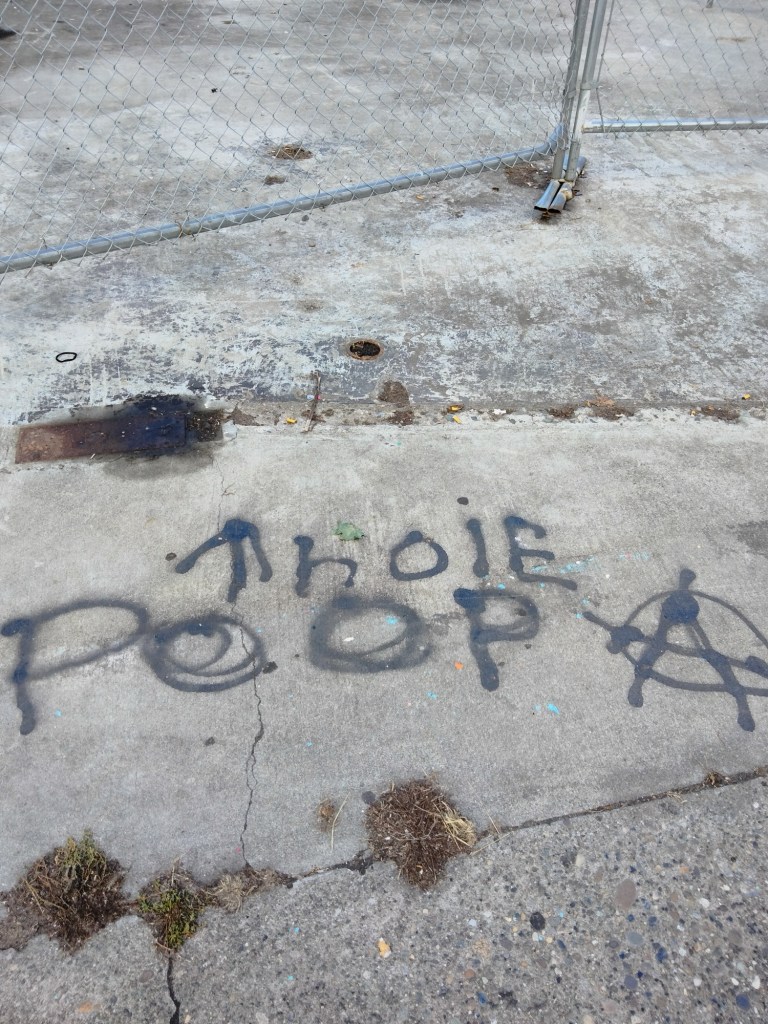
While this step into a deeper layer of symbolic interpretation is an important milestone, I believe that there is more that can be learned from this deceptively simple sign.
2.
Symbolism has a bad reputation in political philosophy, often for good reason. It is frequently associated with esoteric mysticism, elitism, and conspiratorial thinking. This is evident today in right wing politics, which use elaborate, yet ultimately nonsensical theories (think 666, Illuminati, New World Order, QAnon, etc.) to disable critical thinking and create scapegoats — all to distract regular people from the mundane but very real conspiracies of class warfare taking place before their very eyes.
An over-reliance on symbolism runs the risk of coming up with pointless and elaborate systems that lead into a maze of abstraction, a “wilderness of views”, and thus madness. It is important to emphasize, that for Buddhism as well as anarchism, theory is always a theory of practice. Ideas are instrumental. The goal is not rational perfection, but liberatory experience: compassion, wisdom, freedom. Symbols work well when understood as tools in a toolkit for liberation. Like keys, lock picks, bolt cutters, blow torches, and so on, they are for flinging open the doors of the carceral mode of reality we find ourselves trapped in and nothing more.
So why bother with symbolism? First of all, there is no way to avoid it. Symbolism is as old as language — Language is itself symbolic, after all. And it seems that one way of understanding animal cognition, up to and including the human mind, is that brains are, among other things, metaphorical, analogizing, meaning-making organs. What we tend to call consciousness is what happens when the symbols “wake up” and start talking to each other.
CONTINUE READING AT NO SELVES, NO MASTERS

 Non-Buddhism
What do you think?