With John Hawkins, freelance journalist and current Ph.D. candidate at the University of New England (Australia). Frequent contributor to Counterpoint.
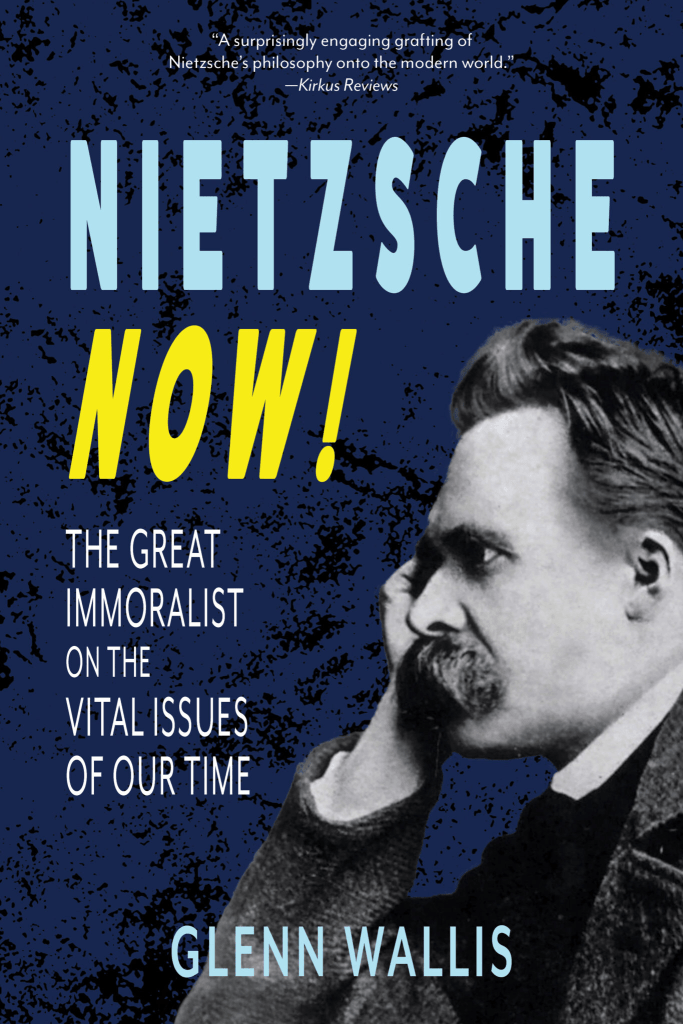
JOHN HAWKINS: Nietzsche Now! The Great Immoralist the Great Immoralist on the Vital Issues of Our Time. Wow. Let’s unpack that title. Why Nietzsche now? What’s so special? Immoralist is a loaded term whose import depends on the point of view of the user. What do you mean? And just what are some of the “vital issues” of our time? Wow.
GLENN WALLIS: H.L. Mencken, who in 1908 (Nietzsche died in 1900) wrote the first study of Nietzsche to appear in the United States, said something to the effect that all complicated issues have answers that are clear, concise, and wrong. A very Nietzschean comment! He says that he hears all around him people bellowing lazy half-baked opinions, politicians screeching illogical ideologically infused polemics, and assorted platitude-prone “improvers of mankind” yammering on about facile “solutions” to our most vexing problems. Sound familiar? How can Nietzsche—and how can we—not conclude that our fellow citizens have a “hatred against reason.” If there were a Nietzschean sin, it would be “to stand in the midst of the discordant harmony of things and the whole wonderful uncertainty and ambiguity of existence without questioning, without trembling with the longing and rapture of questioning.” So, the short answer is: Nietzsche shows us how to question. And I believe that in doing so, he shows us a way forward in our grimly divided world.
How does he do so? Most generally, however, he recommends that we “learn to survey and grasp a single matter from all sides.” I should hastily add two points. The first is that Nietzsche is not advocating the cynical “two-sides” approach of our contemporary right-wing politicians. Indeed, such an approach is far too simplistic for Nietzsche. For him, any given issue has, quite literally, a para-infinite number of sides. The more variously we can consider a matter, the more we are exercising our intellectual conscience and deriving considered reasons for our position. When he says that the eyes must learn to “come-into-its-own,” he means that we must learn to see and think in a way that resists the gravitational pull of “herd” ideology.
The second point is that becoming an acolyte of Nietzschean “perspectivism”—of carefully considering a matter from multiple angles—does not entail infinite deferment of a position. The entire purpose of the exercise is to move, step by step, person by person, toward a future worth living. Ultimately, Nietzsche wants to help create the conditions for new values—values radically different from those that inform what he saw as the West’s dominant forces: capitalism, democracy, the state and Christianity, transcendental idealism, and morality.
This is why Nietzsche calls himself an “immoralist.”
For Nietzsche, there are two massive problems staring us in the face regarding our morality. The first is that we have created a world that “steams with the stench of slaughtered spirit.” In the world we have created, the human being is a diminished little thing, animals are subjected to infernal torture, and the natural environment is desecrated. How can this be “good”? The second is that morality is not the infallible universal gauge of good and evil that it pretends to be. Rather, it is the prescription, or indeed dogma, for what the dominant group in a society deems “good and evil.” In short, whatever preserves the community status quo is good; whatever threatens it is bad.
Nietzsche believed that by thinking outside of the very framework of “morality” per se, the immoralist can view more clearly the workings of the human heart and mind, and far beyond. What makes this possible is that the immoralist—indeed, like amoral nature itself—no longer takes into consideration the “utility of the herd.”
The vital issues of our time that the book deals with are big ones like democracy, identity, consciousness, truth, embodiment, virtue, and overcoming. Many other specific issues of our day are woven in as well, such as “wokeness,” pronouns, LGBTQ++, liberalism and conservatism, and more.
JKH You write of Nietzsche, “His most cherished values were intellectual curiosity and existential courage.” What does that mean? It seems like a long time since Dylan sang about “flesh colored christs that glow in the dark” and not having to look too far to see “that not much is really sacred.” That was like, uh, 1965. Where do we find genuine intellectual curiosity today? Existential courage? What with the climate catastrophe alone, where do we see such courage? How would Nietzsche, the philosopher who came too soon, be helpful to us now that it seems so late?
GW I agree that neither intellectual curiosity nor existential courage are on abundant display these days. Maybe that paucity is yet another reason to read (and to write) a book like Nietzsche NOW!
It is interesting that you cite a lyric from 1965 because that era might have been the last time that something like collective existential courage was on display in a consequential way in the United States. Until now, that is. As we sit here, encamped students at Columbia University and other college campuses are protesting the Israelis excessive response to Hamas’s monstrous attacks on October 7. By doing so, these students face brutal aggression by the police and suspension or expulsion by the university administration. Certainly, whatever your politics, that must count as an example of “existential courage.” While the example might be considered an exception to the rule (of passivity), it might just as well be seen as a harbinger of the courage to come from the younger generation.
But what of “existential courage” in everyday life, the kind that is available to every one of us? Nietzsche asks us to consider two areas where such courage is of dire necessity. The first is in our thinking process itself. So, the first task of existential courage is to resist the “mythical,” the fantastic, and the otherworldly in our very thinking.
JKH Some folks believe that Nietzsche was not necessarily a friend to democracy, given his herd mentality snarking. But you write…

 Non-Buddhism
What do you think?