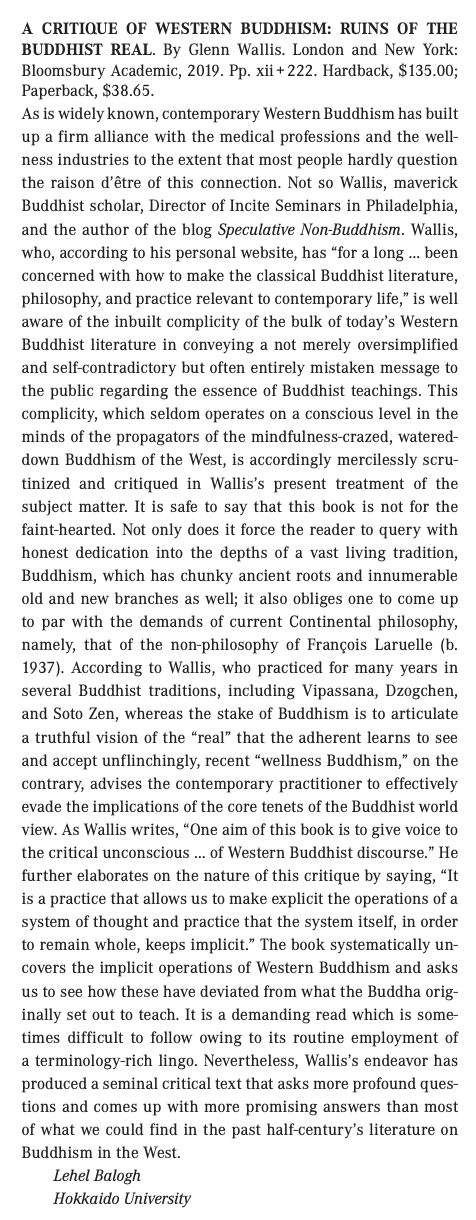
The first review is by Lehel Balogh of Hokkaido University, in Religious Studies Review.
The second review is from Jonathan Gold of Princeton University, in Buddhist Studies Review.
The first review is by Lehel Balogh of Hokkaido University, in Religious Studies Review.
The second review is from Jonathan Gold of Princeton University, in Buddhist Studies Review.


Dear Non-Buddhism / Glenn Wallis,These two reviews are very interesting. I find the second one particularly clear. Thank you for sending these out to us. Ena

It is hard not to see the second review embodying the sufficiency of Buddhism. The dynamics of social processes and the lack of sociological insight in Buddhist texts (as far as I know – I’ve not read much) is evidence for the reviewer missing the point.

You’re very welcome, Ena. Are you by any chance Ena Swansea the artist?
Astute observation, Mark. The academic field of Buddhist studies is filled with people who have a deep sympathy with Buddhism. I can understand that; and I used to be one of those academics myself. In fact, I still have a warm place in my heart for Buddhism and for the Buddha, as I imagine him. BUT, I am happy that my sympathy did not blind me to, well, let’s just call it, as you do, “sufficiency.” I was in any case very pleased that the reviewer took the trouble to read the book and write the review. I have often thought about writing a kind of exposé/criticism of the American field of Buddhist studies, and its historical and ideological roles in the reception of Buddhism here. But I’ve lost my interest in that project. I wish someone else would do it! Anyway, thanks for your comment.

hi Glenn Wallis,
yes, I am a painter. Making non-buddhist non-zen paintings in New York City.
Thank you 🤯 ! e

Interesting reviews. It makes me want to re-read your book Glenn. For me the point of the non-Buddhist critique is the make one ‘mindful’ of concepts like emptiness or even dukkha as soporific rhetorical comforts rather than as pointers to something existentially fearful.
Stephen


What do you think?